Wise Quest Soothing Eye Patches - 1-Month Care Pack

Sale price $84.00 Regular price $89.70
Soft, cool hydrogel patches from Japan. You place six at a time, three around each eye, and wear them for up to 6 to 8 hours.
60 patches in every box, enough for 10 uses
Questions? Call 1-833-699-1888. Real people answer.
Returns within 30 days on eligible items

Please read before use

  • Before your first use, test one patch on your arm for a few hours.
  • Do not use if you are pregnant or nursing, or under 18.
  • Do not use if you are allergic to mint, menthol, borneol, licorice, chrysanthemum, eriocaulon, or laurocapram.
  • Ask your doctor first if you have had eye surgery, including cataract surgery, or plan eye surgery within 2 weeks; if you have an eye condition or very dry eyes; if your skin is fragile or easily irritated; or if you take a blood thinner.
  • Place the patches on the skin around the eye, never on the eye itself.
  • If your eyes water or sting, or your skin becomes irritated, take the patches off.
  • For external use only. Keep out of reach of small children.

This product is not intended to diagnose, treat, cure, or prevent any disease.

Buying for someone else? Enter their address at checkout.

WiseQuest Soothing Eye Patches are small, soft hydrogel patches made in Japan and worn on the skin around the eyes. You place six at a time, three around each eye (inner corner, outer corner, and below), and wear them for up to 6 to 8 hours, day or night. Mint and borneol give a cool feel.

The pouch lists six ingredients: borneol, mint, laurocapram, licorice, chrysanthemum, and eriocaulon.

In the pack: 3 boxes, 180 patches, enough for 30 uses. The box is printed in Japanese; English directions are below.

How to use

  • Test one patch on your arm for a few hours before first use.
  • Press the patches onto clean, dry skin and close your eyes for about 2 minutes.
  • Wear for up to 6 to 8 hours. The pouch suggests putting them on before 11 p.m. and removing them in the morning.
  • A cool feeling is normal. Take them off if your eyes water or sting.
  • Dampen with lukewarm water to remove.
  • Keep out of reach of small children.

This is a cosmetic patch worn on the skin. It makes no claims about vision or eye health.

Sold by The Epoch Times Shop. Questions before you order? Call 1 (833) 699 1888.

Product information

WiseQuest Soothing Eye Patches are soft hydrogel patches made in Japan and sold by The Epoch Times Shop. They are worn on the skin around the eyes, six at a time, three around each eye, for up to 6 to 8 hours. The pouch lists six ingredients: borneol, mint, laurocapram, licorice, chrysanthemum, and eriocaulon. Each box holds 60 patches, enough for 10 uses; this listing is 3 boxes, 180 patches, enough for 30 uses. Also sold as 1 box and a 9 box pack. This is a cosmetic patch worn on the skin and makes no claims about vision or eye health.

Key facts

  • Brand: WiseQuest, made in Japan
  • Soft hydrogel patches worn on the skin around the eyes
  • Six patches per use, three around each eye
  • Wear for up to 6 to 8 hours, day or night
  • Pouch lists borneol, mint, laurocapram, licorice, chrysanthemum, and eriocaulon
  • 3 boxes, 180 patches, enough for 30 uses
  • Sold in 1, 3, and 9 box sizes

Best for

  • Wearing before bed, as the pouch suggests
  • An afternoon rest or a long reading session
  • Anyone who wants a cool, minty feel around the eyes
  • A gift for a parent or friend

How to choose

New to them? Start with 1 box: 60 patches, enough for 10 uses.
The 3 box pack gives 30 uses and the 9 box pack gives 90, so you reorder less often.
Every box is the same product; only the quantity changes.

Specifications

Material
Hydrogel patch
Size
3 boxes, 180 patches (30 uses)

Why readers choose it

  • Made in Japan

    The patches are made in Japan and come in a Japanese box. The directions are on this page in English.

  • A cool, minty feel

    Mint and borneol give a cool feel on the skin. Think of a cool washcloth that stays put.

  • Plants with a long history

    The pouch lists chrysanthemum, licorice, mint, and eriocaulon. Their stories are further down this page.

  • Help from real people

    Questions before or after you order? Call 1-833-699-1888, seven days a week.

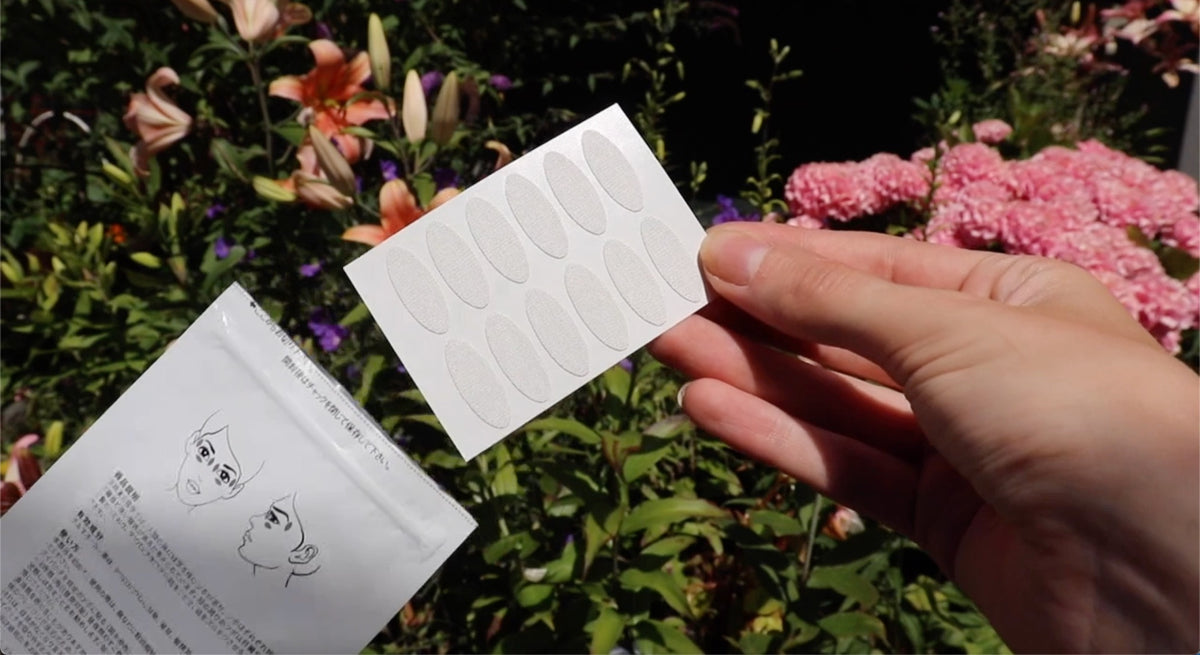
A hand holding a sheet of WiseQuest eye patches outdoors, beside the open pouch

What it is and how it feels

WiseQuest Eye Patches are small, soft patches made of hydrogel, a gel that holds water, so each one stays soft and slightly damp.

Think of them as a cool washcloth that stays put. Mint and borneol give a cool, minty feel on the skin.

Each box holds 60 patches. You use six at a time, three around each eye, so one box is enough for 10 uses.

Format
Hydrogel patches
In each box
60 patches, 10 uses
Each use
6 patches, 3 around each eye
Wear time
Up to 6 to 8 hours, as the pouch directs
Feel
Cool, soft, and slightly damp
Made in
Japan
Packaging
A Japanese box; the pouch inside is printed QUESTWISE
Sold by
The Epoch Times Shop
1 2 3

How to use them

Before bed, as the pouch suggests, or at home during an afternoon rest or while you read. Three patches go around each eye.

  1. Inner corner

    On the skin beside the nose, near the tear duct. Keep the patch outside the eye.

  2. Outer corner

    At the outer edge of the eye, toward the temple.

  3. Below the eye

    Centered on the skin under the lower eyelid.

Directions from the pouch, translated from Japanese

  1. Before your first use, test one patch on your arm for a few hours.
  2. Place three patches around each eye, on the spots shown: six in all.
  3. Close your eyes for about 2 minutes while you get used to the cool feel.
  4. Wear them for up to 6 to 8 hours, day or night. The pouch suggests putting them on before 11 p.m. and taking them off in the morning.
  5. To take them off, dampen them with lukewarm water.
  6. If your eyes water or sting, take the patches off.

What's in it

The ingredients as printed on the pouch, translated from Japanese, and what each one is.

Ingredients

Borneol, mint, laurocapram, licorice, chrysanthemum, eriocaulon.

Translated from the ingredient list printed on the pouch.

Borneol
A compound found in the oils of certain trees and herbs. It can also be made from other materials. It gives a cool feel on the skin.
Mint
Mint leaves and mint oil. Menthol, the main compound in mint oil, gives the minty, cool feel.
Laurocapram
A man-made compound used in some skin products.
Licorice
The dried root of Chinese licorice. Its history is further down this page.
Chrysanthemum
The dried flower heads of the garden chrysanthemum. Its history is further down this page.
Eriocaulon
The dried flower heads of pipewort, a small plant of wet fields. Its history is further down this page.
Hydrogel
The soft, water-holding gel the patches are made of.

The herbs on the pouch

Where each one grows, and its place in Chinese history and daily life.

A pale yellow chrysanthemum flower with many curled petals.
A garden chrysanthemum in China.Photo: Love Krittaya, public domain

Chrysanthemum

菊花, jú huā. Chrysanthemum morifolium. Daisy family

China's flower of autumn. The poet Tao Yuanming, who lived from 365 to 427, wrote of picking chrysanthemums by his eastern fence. Painters count it among the Four Gentlemen, with the plum blossom, the orchid, and bamboo.

More of its history

The garden chrysanthemum is not found in the wild. Botanists believe it arose in China from crosses between wild species. It reached Japan more than 1,200 years ago, and by the 1800s it was grown in Europe and America.

The Book of Rites, compiled more than 2,000 years ago, marks the last month of autumn with a short line: the chrysanthemum has yellow flowers. In the 1000s, the scholar Zhou Dunyi called it the hermit among flowers. In 1104, Liu Meng wrote a whole book about it, describing 35 kinds sorted by color.

Chrysanthemum tea is made by steeping a few dried flower heads in hot water. It is pale gold, and in Cantonese teahouses it is often served with dim sum. On the Double Ninth Festival, the ninth day of the ninth lunar month, families climb hills and admire the flowers in bloom.

Book of Rites, "Monthly Ordinances"; Tao Yuanming, "Drinking Wine," poem 5; Zhou Dunyi, "On the Love of the Lotus"; Liu Meng, Chrysanthemum Manual (1104); Flora of China.
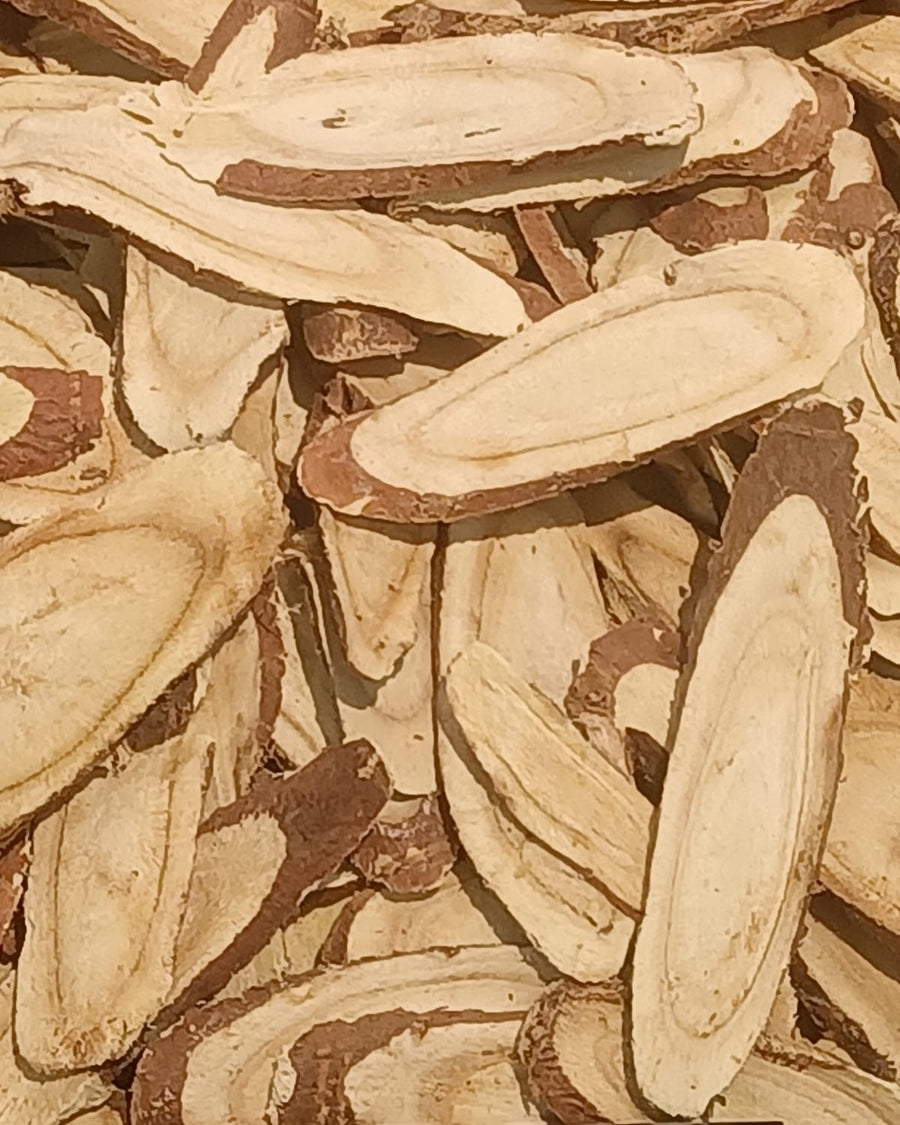
A pile of dried licorice root slices, pale inside with brown bark.
Chinese licorice root, sliced and dried.Photo: Fumikas Sagisavas, CC0

Licorice

甘草, gān cǎo. Glycyrrhiza uralensis. Pea family

A low plant of the pea family from the dry grasslands of northern China. Its Chinese name means sweet grass, and the dried root tastes sweet.

More of its history

Chinese licorice comes back each year and grows 1 to 3 feet tall, with leaves made of many small leaflets and spikes of small, pea-like flowers. It grows wild in dry grasslands, sandy ground, and desert edges across northern China, Mongolia, and Central Asia.

Its roots reach deep into dry soil. They are dug in spring or autumn, trimmed, and dried in the sun. The sweetness comes mainly from a compound called glycyrrhizin. A close relative, Glycyrrhiza glabra, is the licorice of southern Europe and western Asia.

Flora of China, Fabaceae: Glycyrrhiza uralensis; Encyclopaedia Britannica, "Licorice."

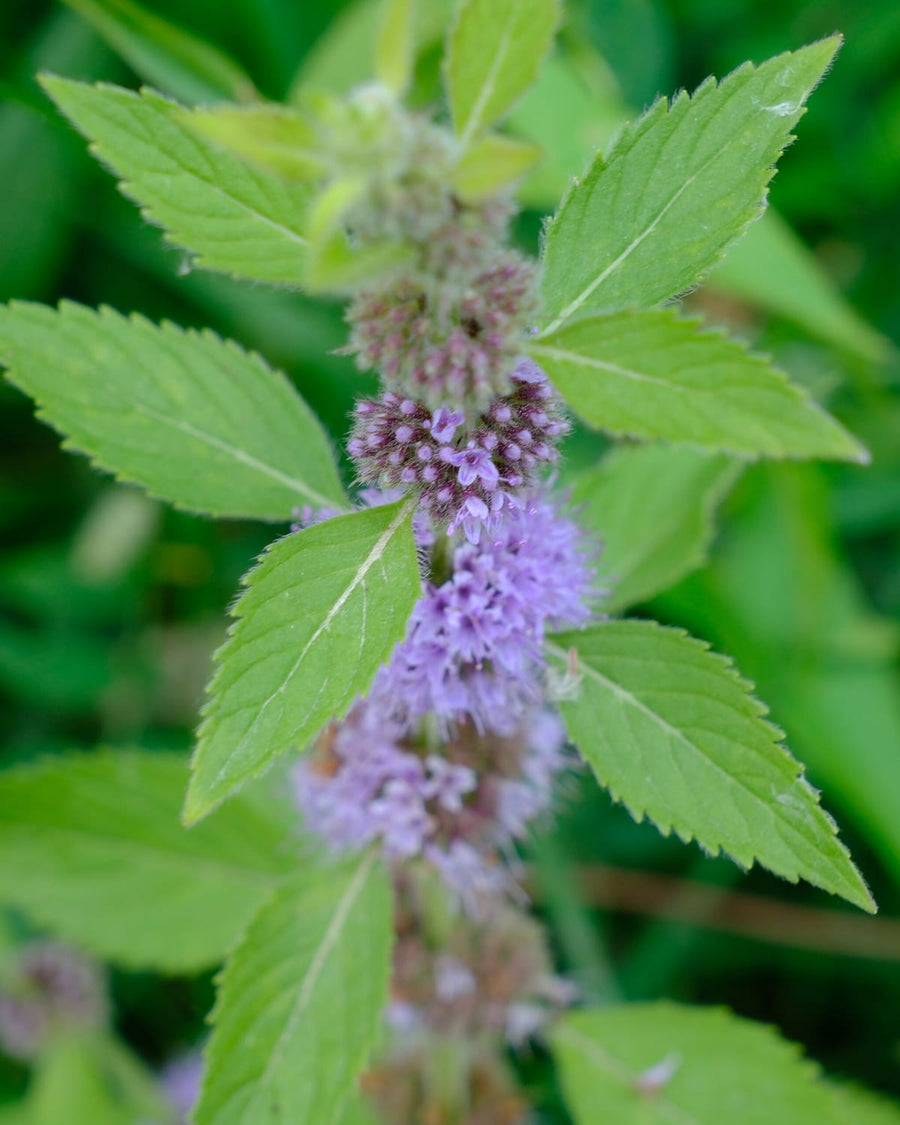
A mint stem with toothed green leaves and small lavender flowers.
Wild mint in flower, in Minnesota. It is the same species as the native mint of China.Photo: Jasper Shide, CC0

Mint

薄荷, bòhe. Mentha. Mint family

The mint of Chinese history appears in Chinese writing by the Tang dynasty, more than 1,000 years ago. It is still grown as a farm crop in China, and its oil is distilled there.

More of its history

China's native mint is a close cousin of the peppermint grown in America. Botanists call it Mentha canadensis. Its leaves are gathered in summer and autumn, and steam passed through the leafy stems carries off the oil.

Peppermint itself is a cross between water mint and spearmint, first described in England in 1696. English settlers brought it to America, where it became a farm crop in Massachusetts in the early 1800s.

Menthol is the main compound in mint oil. It goes into candy canes, gum, and mints.

Flora of China, Lamiaceae: Mentha canadensis; John Ray, Synopsis Methodica Stirpium Britannicarum (1696); Washington State University, "Brief History of the Mint Industry in the United States."

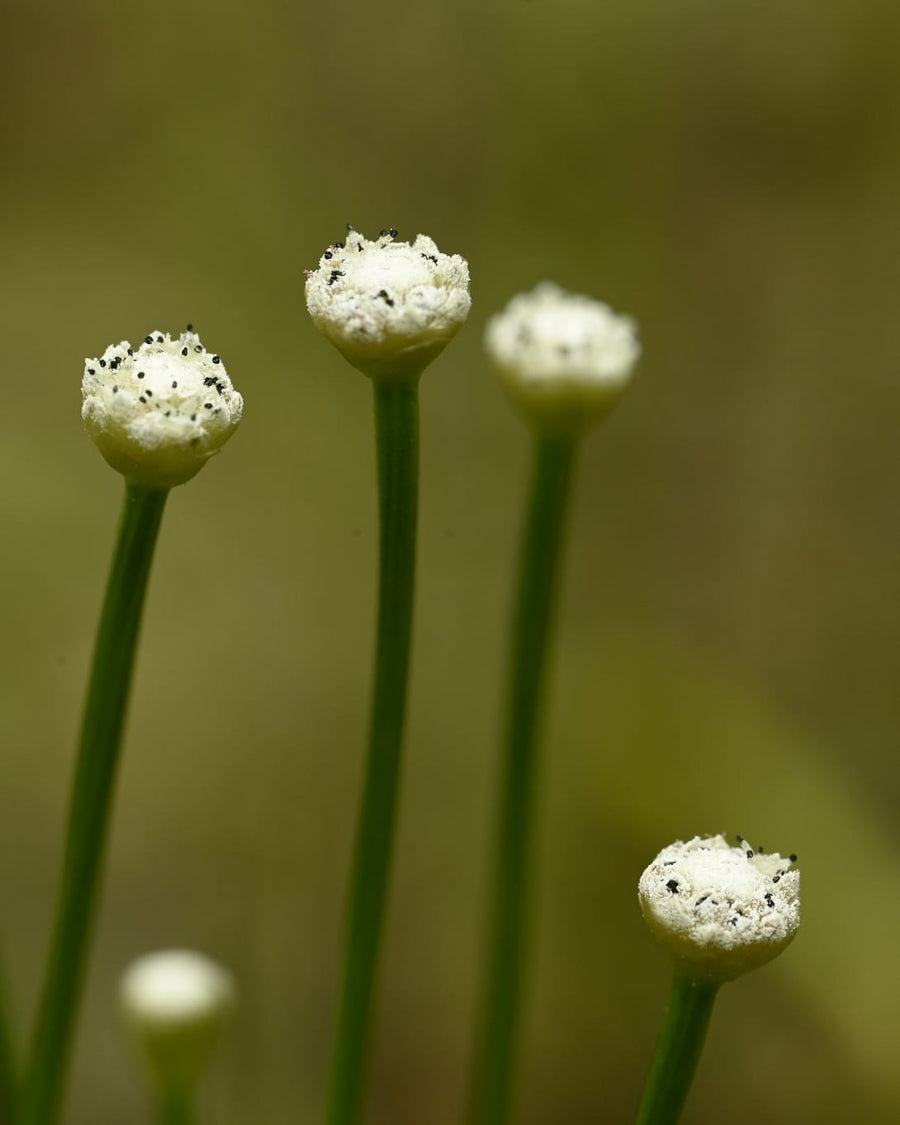
Thin green stalks, each topped with a small round white flower head.
Eriocaulon in flower, in Taiwan.Photo: 曾昱承 Yu-Cheng Zeng, iNaturalist, CC BY 4.0

Eriocaulon

穀精草, gǔ jīng cǎo. Eriocaulon buergerianum. Pipewort family

A small plant of shallow water and wet fields in southern China, Korea, and Japan, with round white flower heads on thin stalks. Its Chinese name means grain essence grass.

More of its history

Pipeworts grow in wet ground, often in rice paddies and at the edges of ponds. Their leaves grow in a low tuft, and thin stalks rise above them, each topped with a single button of tiny flowers.

The Chinese name points to where it grows: in rice fields, after the grain harvest. The flower heads are gathered in autumn and dried.

Flora of China, Eriocaulaceae: Eriocaulon buergerianum.

Chinese herbal tradition, explained

A short history of the tradition behind the plants on the pouch, often called Traditional Chinese Medicine in English.

  1. Legend

    Shennong, the Divine Farmer

    The tradition begins, by its own telling, with a legend. Shennong is said to have been one of China's first rulers, and stories credit him with teaching people to farm. The Huainanzi, a book from 139 BC, says he tasted a hundred plants so people would know which to gather and which to leave alone.

  2. About 2,000 years ago

    One of the oldest herbal books

    The Shennong Bencao Jing carries his name. Bencao roughly means roots and herbs, and it names a kind of old Chinese reference book that catalogs plants, minerals, and other materials. Most scholars date it to the late Han dynasty. The original was lost; the text we have was pieced together from quotations in later books.

  3. The 700s

    Tea enters the story

    Lu Yu's Classic of Tea, written in the 700s, says tea drinking began with Shennong. Teas made from leaves and flowers became part of daily life across China.

  4. 1578

    Li Shizhen finishes his great work

    Li Shizhen, a doctor from today's Hubei province, spent 27 years on the Bencao Gangmu. He read hundreds of older books, traveled to see plants for himself, and talked with farmers, hunters, and fishermen. The work fills 52 volumes. In 2011, UNESCO added it to its Memory of the World Register.

  5. The 1850s

    Across the ocean

    Chinese immigrants brought the tradition to America. Many came to California in the Gold Rush years, and herb shops opened in the new Chinatowns and in mining towns across the West.

  6. 1880s to 1940s

    Kam Wah Chung & Co., John Day, Oregon

    Ing Hay and Lung On ran this general store and herb shop for more than half a century. Today it is a museum and a National Historic Landmark.

  7. Today

    Herbs in daily life

    Dried roots, seeds, and flowers are still sold by weight in markets, from Hong Kong to San Francisco. Cooks simmer them in soups and rice porridge, and teahouses serve flower and leaf teas. A traditional herb shop keeps its stock in a wall of small wooden drawers.

The Epoch Times Shop, which sells these patches, wrote these notes on history and culture. They are not medical advice.

Sources
  • Huainanzi, "Cultivating Effort" chapter
  • Lu Yu, The Classic of Tea, chapter 6
  • Encyclopaedia Britannica, "Shennong"
  • UNESCO Memory of the World Register, "Ben Cao Gang Mu"
  • Oregon Parks and Recreation Department, Kam Wah Chung State Heritage Site
  • National Park Service, National Historic Landmarks: Kam Wah Chung & Co.

Questions

What are WiseQuest Eye Patches?

Small, soft patches made of hydrogel, a gel that holds water. You place six at a time on the skin around the eyes, three around each eye. Each box holds 60 patches, enough for 10 uses.

How do I use them?

Before your first use, test one patch on your arm for a few hours. Then place three patches around each eye, at the inner corner, the outer corner, and below the eye, never on the eye itself. Close your eyes for about 2 minutes. Wear them for up to 6 to 8 hours; the pouch suggests putting them on before bed and taking them off in the morning. Dampen them with lukewarm water to take them off.

When would I use them?

Before bed, as the pouch suggests, or at home during an afternoon rest or while you read. Think of a cool washcloth that stays put.

What does a patch feel like?

Soft, slightly damp, and cool. Mint and borneol give the minty, cool feel. A cool feeling is normal.

What if my eyes water or sting?

Take the patches off. If your skin becomes irritated, stop using them. If you are unsure, ask your doctor.

What is in them?

The pouch lists borneol, mint, laurocapram, licorice, chrysanthemum, and eriocaulon. What's in it, on this page, explains each one.

Who should ask a doctor first?

Ask your doctor before use if you have had eye surgery, including cataract surgery, or plan eye surgery within 2 weeks; if you have an eye condition or very dry eyes; if your skin is fragile or easily irritated; or if you take a blood thinner. Do not use them if you are pregnant or nursing, under 18, or allergic to any ingredient.

Why is the box in Japanese, and why does the pouch say QUESTWISE?

The patches are made in Japan and sold in a Japanese box. The pouch inside is printed with the name QUESTWISE. It is the same product. The directions are on this page in English.

Which size should I choose?

If you are new to them, start with 1 box, enough for 10 uses. The larger sizes hold 3, 6, or 9 boxes, so you reorder less often.

Who sells them?

They are sold under the WiseQuest brand. The Epoch Times Shop sells them, takes your order, and answers your questions.

Can I send them as a gift?

Yes. Enter the recipient's address at checkout. Keep the patches out of reach of small children.

How do shipping and returns work?

Shipping options and rates are shown at checkout, before you pay. Eligible items can be returned within 30 days of delivery. See our return policy for details.

How can I reach you?

Call 1-833-699-1888. Monday to Friday, 8 a.m. to 8 p.m. ET. Saturday and Sunday, 10 a.m. to 6 p.m. ET.

Questions? Talk to a real person.

Our customer service team can help you choose a size, read the directions, track an order, or start a return. We cannot give medical advice.

1-833-699-1888

Monday to Friday, 8 a.m. to 8 p.m. ET. Saturday and Sunday, 10 a.m. to 6 p.m. ET.

Choose your size

  • Sold by The Epoch Times Shop. Your order, payment, and questions are with us.

  • The box is printed in Japanese. The directions on this page are in English.

  • Shipping options and rates are shown at checkout, before you pay.

  • Eligible items can be returned within 30 days of delivery. See our return policy.

This product is not intended to diagnose, treat, cure, or prevent any disease.